
 Close
Close- Trademarks & Designs

- Trademarks & Designs
- Strategy & managementUnlock the potential of your brand portfolio
- SearchingScreening and clearance search with smart pre-selection
- RegistrationTailored support to maximise your brand potential
- WatchingMonitor rights efficiently and cost-effectively worldwide
- Monitoring & prosecutionProtect and enforce rights on- and off-line
- Renewals & recordalsFlexible renewal and recordal services
- Strategy & management
- IP consultingBrand development, audits, licensing, M&A, valuation/monetisation, contract management and more
- IP consulting
- Patents
- Solutions
- Trademarks & Designs
- Trademarks & Designs
- Strategy & managementUnlock the potential of your brand portfolio
- SearchingScreening and clearance search with smart pre-selection
- RegistrationTailored support to maximise your brand potential
- WatchingMonitor rights efficiently and cost-effectively worldwide
- Monitoring & prosecutionProtect and enforce rights on- and off-line
- Renewals & recordalsFlexible renewal and recordal services
- Strategy & management
- IP consultingBrand development, audits, licensing, M&A, valuation/monetisation, contract management and more
- IP consulting
- Patents
- Solutions
- Contact
- About us
- About us
- About usProud to support iconic brands and innovative organisations worldwide
- Mission & visionDiscover how we are redefining IP management through dynamic, strategic and personalised services
- MilestonesExplore our history from our founding 135+ years ago to the present day
- Our offices18 offices and unique network of specialists delivers local expertise on a global scale
- Social responsibilityWe strive to positively impact the environment and the global community in which we work and live
- GovernanceInnovation, client focus and a passion for IP. Meet our management team
- About us
- Careers
- Log in
- About us
- About us
- About usProud to support iconic brands and innovative organisations worldwide
- Mission & visionDiscover how we are redefining IP management through dynamic, strategic and personalised services
- MilestonesExplore our history from our founding 135+ years ago to the present day
- Our offices18 offices and unique network of specialists delivers local expertise on a global scale
- Social responsibilityWe strive to positively impact the environment and the global community in which we work and live
- GovernanceInnovation, client focus and a passion for IP. Meet our management team
- About us
- Careers
- Log in
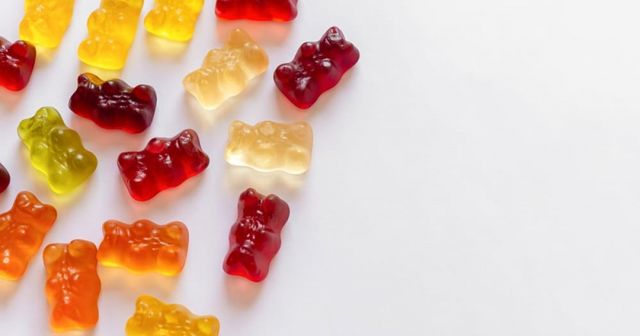
Haribo’s gummy bear trademark deemed too simple by EU Court
Haribo's EU trademark application for its Goldbears teddy bear was rejected by the EUIPO due to a lack of distinctiveness. Now the EU General Court has confirmed that the two-dimensional figurative trademark is too simple and too decorative to qualify for trademark protection, as Armelle Blachier explains.
This case concerns the refusal to register a European Union (EU) trademark (no. 1700702) to protect a figurative trademark, namely the shape of the Haribo Goldbears teddy bear. The European authorities were not convinced that the proposed mark would be able to fulfil the essential function of a trademark – namely, to identify a product from a specific company – due to its geometric simplicity.
Background to the Haribo trademark dispute
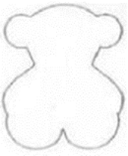 Through its holding company, Rigo Trading SA, confectionery company Haribo sought to protect its Goldbears gummy bear, created in 1920, within the territory of the EU by filing a two-dimensional trademark (pictured right) in April 2022 to designate a broad category of products, without necessarily targeting sweets.
On the basis of Article 7(1)(b) of Regulation 2017/1001, the European Union Intellectual Property Office (EUIPO) rejected this trademark application, considering that it did not possess sufficient distinctiveness to be registered.
The Fifth Board of Appeal of the EUIPO confirmed this analysis (R 2150/2023-5), considering that the mark would be perceived as a decorative element without distinctive character or an ornament for aesthetic purposes, not allowing the products of a company to be distinguished.
The decision of the General Court
On 16 July 2025, the General Court of the European Union agreed with these findings, recalling that: “for a trademark to possess distinctive character [...] it must serve to identify the product in respect of which registration is sought as originating from a particular undertaking, and thus to distinguish those goods from those of other undertakings.”
The Court then upheld the refusal to register the shape of the gummy bear trademark due to the lack of this distinctive character, noting that the sign, composed of a thick black line outlining a closed shape with curved sides on a white background, is a simple "two-dimensional geometric figure of no particular complexity".
The Court added that “the applicant has not shown that the relevant public would recognise, in the mark applied for, the body parts of a bear, such as its ears, arms, legs and head”. Similarly, “it has not shown that that public would recognise that that mark represented the outline of a Haribo Goldbear gummy bear.”
 Rigo Trading attempted to argue that its other trademark (pictured right), representing the same Goldbear teddy bear, had been deemed distinctive by the European Union authorities (EUIPO Fourth Board of Appeal decision no. R 872/2023-4 of 11 October 2023).
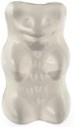
However, the Court clarified that the signs in question must be assessed differently since the latter is a three-dimensional trademark (and not two-dimensional as in our specific case), and that it appears more complex due to its "compact shape showing a head with straight ears, eyes, a nose and a smile, but also paws stretched out like two arms and two legs, as well as a shiny surface.”
Are the EU courts becoming more severe?
 This decision appears to mark a step towards greater severity on the part of European authorities towards two-dimensional trademarks made up of simple geometric shapes. This appears to be the case, even though just two years earlier, in July 2023, the EU General Court accepted the trademark (shown left), which is the outline of a bear (decision no. T 591/21).
Rigo Trading also attempted to invoke this case, but without success.
 This latest ruling thus confirms the ruling in Chiquita (T-426/23) rendered by the EU Court in November 2024, which cancelled the trademark (shown left) for fresh fruit on the basis it was a simple geometric figure; namely, a variation of an oval, without easily and immediately memorable characteristics.
 As we covered at the time, Chiquita had also failed to demonstrate that its trademark had acquired a distinctive character through use throughout the EU, which would allow it to identify the commercial origin of the products in question.
In the case at hand, the Court did not rule on the possibility that the trademark (shown left) had acquired a distinctive character through use. Indeed, the Board of Appeal has decided to refer the case back to the Examining Division to consider the subsidiary claim of distinctiveness acquired through use.
Rigo Trading could still try to invoke this ground; however, establishing distinctive character acquired under Article 7(3) of Regulation 2017/1001 remains complicated since it requires evidence in all EU member states, a burden that even the best-known brands have struggled to achieve in the past.
We will be following closely the actions that Haribo takes next. In the meantime, please speak to your Novagraaf attorney or contact us below for targeted advice on protecting figurative trademarks and other valuable brand rights.
Armelle Blachier is a Trademark and Design Attorney at Novagraaf in Paris.